Tuesday, May 29, 2018

More people are saving $1 million in their 401(k)s. Here's how you can too

Saving $1 million for retirement may sound like an impossible task that not many people have achieved.

But about 157,000 people have saved at least $1 million in their 401(k)s with Fidelity, according to the company.

Another 148,000 had saved that much in an IRA.

Of those, 2,400 people had saved $1 million in both types of accounts.

So what's the secret to becoming one of them? Time.

Most of these people are Baby Boomers who have saved for at least 30 years.

"I think the most important behavior is to start saving early," said Katie Taylor, vice president of thought leadership at Fidelity.

That's good news for Millennials. If you're still in your 20s or 30s, you can set yourself up now to meet that goal with much less effort than an older person getting a later start.

People who've reached the $1 million mark also are saving a bigger percentage of their salary. Those with $1 million in their 401(k) are saving 24% of their salary each year �� including both employer and employee contributions. Overall, the average 401(k) participant is saving 13%, according to Fidelity, the biggest plan provider by assets.

"The beauty of the 401(k) is that it takes the emotion out of investing," said Chuck Cumello, president and CEO of Essex Financial.

Since money is taken out of your paycheck automatically, you're less likely to try to time the market.

How do you stack up?

Less than 3% of Baby Boomers with a 401(k) at Fidelity have reached $1 million.

In 2016, working households aged 55 to 64 with retirement accounts had saved a median of $120,000, according to the Investment Company Institute.

It's no surprise that those with higher salaries have saved more. Those older households who earned more than $171,000 a year had saved a median of $600,000 while those who earned less than $35,000 a year had saved a median of $18,000. (The report considered assets in all defined contribution accounts, including both 401(k) and IRAs.)

How can you get to $1 million?

Not everyone will need $1 million for retirement, Taylor said. One rule of thumb is to save 10 times your ending salary. If you're far away from retirement age, use an online calculator like this one to get an idea of how much you might need.

There are three common traits shared by those who have saved a lot of money in their 401(k)s, said Cumello.

1. Start saving early.

If you start at age 25, you'll need to save $650 a month to have $1 million by age 65. But you'd need to save $1,200 a month if you wait to start saving until age 35 (assuming a 5% average return).

Calculator: When will I be a millionaire?

2. Work toward saving the maximum allowed.

First, save at least as much to get the full company match, Cumello said.

Then increase your savings rate until you hit the federal limit. This year it's $18,500.

3. Pay attention to your investments.

Most 401(k)s have low-cost fund investment options. Cumello suggests investing in those to create a diversified portfolio. Avoid being too heavily invested in one stock.

Are you on track to save $1 million for retirement? Share your story with CNN Money.

Sunday, May 27, 2018

Your Evening Briefing

Want to receive this post in your inbox every afternoon? Sign up here.

Maybe the North Korea talks will happen after all. As President Donald Trump departed Washington for the holiday weekend, he mused of revisiting the decision to call off the summit, his latest policy about-face. Meanwhile, one person who won’t be traveling far anytime soon is ex-film mogul Harvey Weinstein, who was arrested.  

Here are today’s top stories

Taiwan is losing friends as China’s efforts to isolate the island nation are accelerating, leaving only 18 countries who recognize the country formally known as the Republic of China.

The People's Republic of China, meanwhile, got some good news—courtesy of Trump. The administration told Congress it will allow Chinese telecom firm ZTE Corp. to remain in business.

In just six weeks, Saudi Arabia has gone from advocating higher oil prices to trying to stop the rally at $80 a barrel. What's going on in Riyadh?

These American workers are still being paid like it’s the 1980s, thanks to the government’s decades-long failure to update the “prevailing wage” for jobs needed on taxpayer-funded projects.

Europe has had enough of Brexit. Leavers hoped to start a continent-wide revolution, but it turns out there are more pressing problems.

Crypto fever may have cooled across much of the globe, but don’t tell that to folks in Caracas. They’re mining coins like crazy in Venezuela.

What's Lorcan Roche Kelly thinking? The Bloomberg Markets editor says the reason a new order in Italy threatens a wider European crisis is because the lessons from the last crisis weren't put into practice.

What you’ll need to know tomorrowApple's famed designer reveals the secrets of the Apple Watch.Malaysian police seized $29 million in raids linked to former Prime Minister Najib Razak.Amazon is scaring the heck out of big box retailers, who suddenly recognize their peril. Amazon is scaring some consumers, because Alexa might be listening.Some of America’s biggest newspapers and online services are cutting off Europe.Trump is rushing to cut the red tape that keeps commercial rockets on the ground.Meanwhile, the firm Jared Kushner ran just sold its stake in some killer courtyard parties.What you’ll want to read tonight

Welcome to America’s most glamorous wine extravaganza. A hair-raising ride with race car driver Danica Patrick, a masked ball at Versailles, a visit to a camel racetrack in Abu Dhabi, and, of course, rare California wines: That’s a tiny taste of what’s on offer at the 38th extravagant Auction Napa Valley.

LISTEN TO ARTICLE 2:31 Share Share on Facebook Post to Twitter Send as an Email Print

Saturday, May 26, 2018

Leverage Alert Ringing While Cash Drains From Stock Broker Accounts

Few things evoke fear in markets like a margin call. Now there are signs that many U.S. stock investors are ill-prepared to deal with one.

The issue is net cash in equity brokerage accounts, seen by some as a proxy for how well-cushioned traders are from forced liquidations if stocks start to plummet. It’s calculated by subtracting the amount of debt used to buy securities from money in an account that’s available to buy more.

And right now, it’s perilously low.

#lazy-img-328040338:before{padding-top:56.25%;}

The deficit just reached $317 billion, the widest ever, according to New York Stock Exchange data compiled by Sundial Capital Research Inc. The previous record was set in January, right before the S&P 500 Index suffered its first 10 percent correction in two years.

Cash “seems to provide less of a cushion for any decline in the value of stock,” Jason Goepfert, president of Sundial Capital Research Inc., wrote in a note to clients. “That is clearly concerning.”

There are few topics in the market subject as much demagoguery as margin debt, and a standard critique over the the period of the bull market has been that it’s at untenable levels -- $652 billion, by the NYSE’s last count. What’s usually lost in the discussion is that such debt basically always rises with the value of equities -- the two are virtually synonymous since one collateralizes by the other.

What’s bad is when the expansion of margin comes untethered from the slope of equities, signaling people are taking out loans even faster than stocks are appreciating. That happened in the final year of the last two bull markets, when margin loan growth outpaced share gains by twofold in 2007 and almost four times in 2000.

Nothing like that is happening now. At the same time, a similarly dire picture is evident when cash credits in brokerage accounts are taken into consideration. Available for investors to withdraw at any time, for any purpose, they include proceeds from short sales and extra buying power held in margin accounts. Last month, they fell 3.3 percent to $335 billion, the lowest level in four years.

Think of the money as assets on a balance sheet and stock loans as liabilities. As traders withdrew cash while at the same time raising debt, their financial health, or in Sundial’s term “net wealth,” deteriorates.

“Debt alone doesn’t tell the whole story,” Goepfert said. “The new record in negative net worth is most concerning, just not as concerning as it would be if the growth in debt was more extreme. The latest drop in net worth is due more to a drain of cash out of accounts as opposed to an increase in debt. Maybe that’s just as worrisome.”

LISTEN TO ARTICLE 2:33 Share Share on Facebook Post to Twitter Send as an Email Print

Thursday, May 24, 2018

J.C. Penney's Performance Isn't Convincing

If only Sears Holdings (NASDAQ:SHLD) would hurry up and go out of business faster, maybe J.C. Penney (NYSE:JCP) would have a better chance itself at surviving. J.C. Penney CEO Marvin Ellison, who just resigned to take over the top executive position at home improvement center Lowe's, told analysts during the first-quarter earnings conference call in mid-May that, "when we see a Sears close, it's a significant benefit to our business."

Of course, Penney's best-performing stores also tend to be in malls that have a Sears, so it's a bit of a conundrum for the retailer, though investors can't be happy that J.C. Penney has seemingly hitched its recovery wagon to a failing rival.

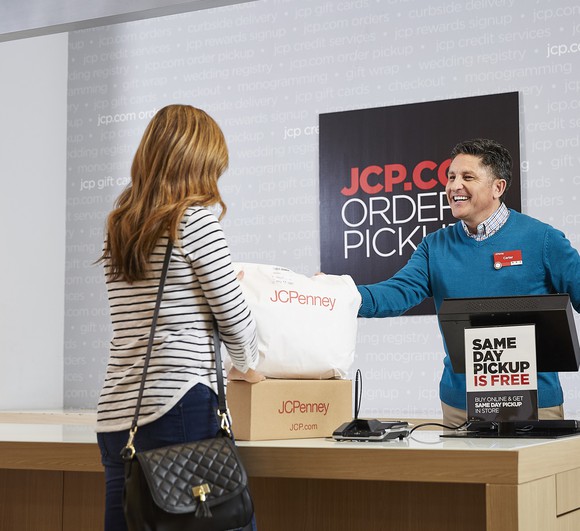
Woman picking up packages at J.C. Penney counter.

Supply chain issues helped sink J.C. Penney margins in Q1. Image source: J.C. Penney.

Not rising to the challenge

Considering how poorly Sears performed in the first quarter, one might think J.C. Penney should have done a lot better. Sears' customers continued to abandon it in droves, with comparable-store sales plunging by mid-teen rates, but J.C. Penney could only scrounge up comps growth of 0.2%, near the very bottom of its guidance of flat to 2% growth.

And this comes even though J.C. Penney is purposefully trying to steal Sears customers by adding appliances to its stores and modifying its home department. Although it reportedly enjoyed 15% comps growth in appliances, it's still only a small component of the retailer's business and couldn't come near to offsetting the declines it experienced elsewhere.

Women's apparel has long been J.C. Penney's money center, generating about a quarter of total revenues,�but lately it hasn't been able to move merchandise. Even after liquidating a lot of the inventory last year, the department store chain still had to execute clearance markdowns to address items that weren't selling, which pressured margins. Management had said margins would likely be lower in the first quarter, but the percentage-point drop it posted was worse than expected.

I don't buy it

The retailer puts part of the blame on the weather, but the cooler temps didn't seem to effect Macy's (NYSE: M), which reported truly robust results that had many expecting J.C. Penney would follow suit. Although Macy's did say a few markets were impacted, they were offset by others that were not. That weather should drag down Penney when it has more stores than its rival -- which should have spread out the impact more -- indicates it is more of an excuse than a reason.

That's why J.C. Penney's problems with its online business are a concern. It faced a number of supply chain issues in the period that prevented it from getting product to customers in a timely manner causing J.C. Penney to have to discount merchandise, which was another pressure point on margins.

As consumers increasingly shop online --�Amazon.com�is poised this year to surpass Macy's as the largest apparel retailer -- J.C. Penney has sought to better blend its digital business with its physical one, even fulfilling and shipping online orders from it stores. Stumbling over that at the same time it is making an apparent fashion faux pas with apparel will only serve to chase customers further away.

The turnaround that wasn't

But it was J.C. Penney's revised guidance that seemed to worry the market the most. The department store said its full-year earnings could end up anywhere between a $0.07 loss and a $0.13 profit per share, a dramatic change from the previous range of profits of $0.05 to $0.25 per share. While both ranges tend to be wide enough to drive a truck through, it's clear J.C. Penney's position is deteriorating even as rivals like Macy's rebound.

By measuring its performance against Sears, the retailer is taking the approach that it's not as important that it succeeds, but that its competitor fails. Yet even after Sears reported its own dismal earnings results, J.C. Penney still couldn't come up with a win. Rather than being in the midst of another recovery effort, it may actually be preparing for a second trip to the brink.

Wednesday, May 23, 2018

Aehr Test Systems (AEHR) Insider David S. Hendrickson Sells 5,000 Shares

Aehr Test Systems (NASDAQ:AEHR) insider David S. Hendrickson sold 5,000 shares of the stock in a transaction dated Tuesday, May 22nd. The shares were sold at an average price of $2.37, for a total transaction of $11,850.00. Following the completion of the sale, the insider now owns 25,351 shares of the company’s stock, valued at approximately $60,081.87. The sale was disclosed in a filing with the Securities & Exchange Commission, which is available through this hyperlink.

Shares of AEHR stock traded up $0.02 on Tuesday, hitting $2.39. The stock had a trading volume of 44,848 shares, compared to its average volume of 67,922. The company has a market cap of $52.25 million, a P/E ratio of -8.24 and a beta of 0.82. The company has a debt-to-equity ratio of 0.33, a current ratio of 4.62 and a quick ratio of 3.20. Aehr Test Systems has a 12-month low of $2.12 and a 12-month high of $4.83.

Get Aehr Test Systems alerts:

Aehr Test Systems (NASDAQ:AEHR) last posted its quarterly earnings data on Tuesday, April 3rd. The semiconductor company reported $0.01 earnings per share (EPS) for the quarter. Aehr Test Systems had a negative net margin of 1.58% and a negative return on equity of 1.41%. The business had revenue of $7.39 million during the quarter.

Hedge funds and other institutional investors have recently bought and sold shares of the stock. Keybank National Association OH purchased a new stake in Aehr Test Systems during the fourth quarter worth about $213,000. Virtu Financial LLC purchased a new stake in Aehr Test Systems during the fourth quarter worth about $299,000. Segall Bryant & Hamill LLC purchased a new stake in Aehr Test Systems during the first quarter worth about $322,000. B. Riley Financial Inc. increased its holdings in Aehr Test Systems by 520.0% during the first quarter. B. Riley Financial Inc. now owns 155,000 shares of the semiconductor company’s stock worth $349,000 after buying an additional 130,000 shares during the last quarter. Finally, Deutsche Bank AG purchased a new stake in Aehr Test Systems during the fourth quarter worth about $381,000. Institutional investors and hedge funds own 22.61% of the company’s stock.

Aehr Test Systems Company Profile

Aehr Test Systems designs, engineers, manufactures, and sells test and burn-in equipment used in the semiconductor industry worldwide. The company offers full wafer contact test systems, test during burn-in systems, test fixtures, die carriers, and related accessories; and Advanced Burn-in and Test System family of packaged part burn-in and test systems, which perform test during burn-in of complex devices, such as digital signal processors, microprocessors, microcontrollers, and systems-on-a-chip, as well as offer individual temperature control for high-power advanced logic devices.

Insider Buying and Selling by Quarter for Aehr Test Systems (NASDAQ:AEHR)

Tuesday, May 22, 2018

Zacks: Analysts Anticipate Sierra Oncology (SRRA) to Post -$0.17 EPS

Wall Street analysts forecast that Sierra Oncology (NASDAQ:SRRA) will report earnings per share of ($0.17) for the current quarter, according to Zacks. Zero analysts have made estimates for Sierra Oncology’s earnings. The highest EPS estimate is ($0.16) and the lowest is ($0.17). Sierra Oncology reported earnings per share of ($0.20) in the same quarter last year, which suggests a positive year over year growth rate of 15%. The company is expected to announce its next earnings report on Thursday, August 9th.

According to Zacks, analysts expect that Sierra Oncology will report full-year earnings of ($0.75) per share for the current year, with EPS estimates ranging from ($0.85) to ($0.68). For the next fiscal year, analysts expect that the firm will post earnings of ($0.75) per share, with EPS estimates ranging from ($0.78) to ($0.72). Zacks’ EPS averages are an average based on a survey of analysts that cover Sierra Oncology.

Get Sierra Oncology alerts:

Sierra Oncology (NASDAQ:SRRA) last posted its quarterly earnings results on Thursday, May 10th. The biotechnology company reported ($0.19) EPS for the quarter, topping the consensus estimate of ($0.21) by $0.02.

SRRA has been the topic of several analyst reports. Zacks Investment Research lowered Sierra Oncology from a “hold” rating to a “sell” rating in a report on Friday, March 2nd. ValuEngine upgraded shares of Sierra Oncology from a “hold” rating to a “buy” rating in a report on Wednesday, May 2nd.

Shares of NASDAQ SRRA traded down $0.05 during trading on Monday, hitting $2.57. 453,200 shares of the company were exchanged, compared to its average volume of 563,468. Sierra Oncology has a 12-month low of $1.10 and a 12-month high of $4.09. The firm has a market cap of $194.70 million, a PE ratio of -3.06 and a beta of 2.37.

A number of institutional investors and hedge funds have recently modified their holdings of SRRA. Acadian Asset Management LLC raised its holdings in Sierra Oncology by 112.3% in the 4th quarter. Acadian Asset Management LLC now owns 32,437 shares of the biotechnology company’s stock valued at $121,000 after buying an additional 17,161 shares during the period. Candriam Luxembourg S.C.A. purchased a new stake in Sierra Oncology in the 4th quarter valued at about $2,238,000. Bank of New York Mellon Corp purchased a new stake in Sierra Oncology in the 4th quarter valued at about $280,000. Sphera Funds Management LTD. purchased a new stake in Sierra Oncology in the 4th quarter valued at about $2,052,000. Finally, AWH Capital L.P. purchased a new stake in Sierra Oncology in the 4th quarter valued at about $2,555,000. Hedge funds and other institutional investors own 66.67% of the company’s stock.

Sierra Oncology Company Profile

Sierra Oncology, Inc, a clinical stage drug development company, researches, develops, and commercializes DNA Damage Response (DDR) therapeutics for the treatment of patients with cancer in the United States and internationally. The company's lead drug candidate is SRA737, an orally bioavailable small molecule inhibitor of Checkpoint kinase 1, which is in Phase 1 clinical trial to treat patients with advanced cancer.

Get a free copy of the Zacks research report on Sierra Oncology (SRRA)

For more information about research offerings from Zacks Investment Research, visit Zacks.com

Earnings History and Estimates for Sierra Oncology (NASDAQ:SRRA)

Monday, May 21, 2018

Indoco Remedies gains 2% on no observation from USFDA for Rabale unit

Shares of Indoco Remedies rose over 2 percent intraday Monday as USFDA has successfully completed the inspection at its manufacturing facilities.

United States Food and Drug Administration (USFDA) has successful completed inspection at company's API manufacturing facilities at Patalganga and Rabale, Navi Mumbai.

The routine FDA inspection was conducted at Patalganga facility from May 7 to 11, 2018 and Kilo Lab facility at Rabale from 14 to 17, 2018, company said in release.

During the audit, the FDA thoroughly inspected Indoco's entire quality management systems to ensure compliance with federal regulations.

The inspection included a review of production facility, processes and procedures, training records, quality systems and control procedures.

The Kilo Lab facility received zero 483s from the agency, while its API plant at Patalganga cleared the inspection with 3 observations; none of them are critical or pertain to data integrity.

At 09:44 hrs Indoco Remedies was quoting at Rs 180.80, up Rs 3.90, or 2.20 percent on the BSE.

Posted by Rakesh Patil